
With increasing temperature, the toxic ozone levels, which cause a number of health problems especially for asthmatics, have breached the permissible limits in the city, the MET department said on Thursday.
Rain for the central and northwestern parts a concern.
However, it's too soon to see any trend; July rain is key.
Delhi recorded 8.6 on the UV index on Tuesday while it was 8.2 at noon on Wednesday.

'Keeping the global temperature below not just 1.5 degree Celsius, even 2 degree Celsius is beyond our reach now. Both are impossible.'
IMD has decided to increasingly use cutting-edge technology such as artificial intelligence (AI) and machine learning (ML) in forecasting, both to avoid such glitches and to counter the disruption of normal seasonal patterns as a result of climate change. It has formed various internal sub-groups of senior officials and meteorologists to decide on how best to use AI and ML in predicting cyclone intensity, and in making short-range weather forecasts (those valid for up to three hours) as well as long-range forecasts.

'The food security along the coastal region will be severely affected.'

According to SAFAR, both stubble burning in surrounding states of Delhi and firecrackers are causing deterioration of air quality in the national capital.
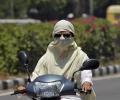
Data show that the ultra-violet radiation index is dangerously high in Delhi, other Indian cities.
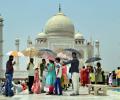
The experts said that climate change is not only raising temperatures and making India's heatwaves hotter, but also changing weather patterns that further drive dangerous weather extremes.

At a virtual press conference to launch the report, Inger Anderson, Executive Director, United Nations Environment Programme, said, "Climate change is here and now. No one is safe. Despite warnings from so many years, the world did not listen. We need to act now. Reducing greenhouse gas emissions will not only limit climate change but also reduce air pollution."

Air quality in the national capital deteriorated alarmingly a day after Diwali as pollution levels spiked more than five times higher than normal leaving many at the risk of respiratory problems.

Pollution levels were inching towards 'severe plus emergency' category due to a change in wind direction and rampant stubble burning in neighbouring states
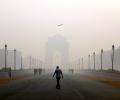
The problem is so severe that multiple agencies have issued several precautionary measures.

'We will have to face the effects of climate change for generations to come!'

'Storms push a lot of water into land, then there is heavy rainfall due to the cyclone.' 'Along with this, we see the gradual rising of the sea level.' 'We see this during and after the latest Cyclone Tauktae.' 'This kind of overlapping events are increasing and we do not know much about how to tackle them.'
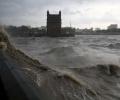
'Each cyclone has its own identity and its own behaviour based on the environmental conditions in the ocean and in the atmosphere.'

'It affects our economy, it is very important in many ways.' 'So we have to be the foremost experts in the world on the monsoon.' 'But the best minds in India have not devoted their time to the study of monsoon and they have followed the fashions of the West.'

Though the summer is expected to be hotter, global and domestic forecasts point to good rains.

'All El Ninos are not associated with the deficient monsoon.'

Given the intensity of the rain, at least a third of this crisis could have been averted, had Tamil Nadu heeded Kerala's requests.

We need to invest in the science of monsoons and weather forecasting.
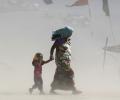
'It is high time that we act instead of just talking about how and why the climate is changing.'

Scientists at the India Meteorological Department warn that not only has India turned hotter in the last two decades, but that heat waves are projected to become more intense, have longer durations and greater frequency, thereby resulting in more deaths.
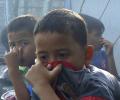
Air toxics emissions are high from older vehicles.

What are the most worrisome aspects of climate change for India? Can they be solved?

Markets closed in the red on domestic worries.

'They don't always agree with our governments, their teachers or their parents, but it is the conviction of their ideas, and their determination to share them with the world that, I believe, is one of the greatest sources of hope for our planet.' 'The colonisation of space, understanding the very building blocks of matter and the universe, utilising our understanding of the human genome to conquer disease -- these are the tasks waiting for a fellowship of minds to realise new triumphs in our collective destiny.'

Once called India's garden city, this upper middle-class residential area in Bangalore has India's most toxic air, says Devanik Saha, IndiaSpend.com.

Orissa learnt its lessons from previous cyclones, particularly the 1999 super cyclone, whereas Uttarakhand has failed to do so from any of the previous natural calamities that hit the state, says Dinesh C Sharma.
